Every founder, from first-time builders to experienced operators, faces similar challenges when bringing a product to life. Work slows down. Decisions take longer than they should. Requirements shift from sprint to sprint.
Instead of focusing on customers and growth, they end up managing the team that should be pushing work through the development process.
Why does this happen?
Most product development teams face this challenge because their structure creates friction: too many layers, too many handoffs, and insufficient clarity.
Our model removes this friction entirely.
At Absolute App Labs, we bring a senior-led, engineering-first team designed to accelerate progress and deliver products that hold up in the real world, not just in demos, making us one of the best product development teams for startups looking for predictable execution and long-term stability.
Here’s how we solve the problems founders face with most product development teams and deliver more scalable outcomes.
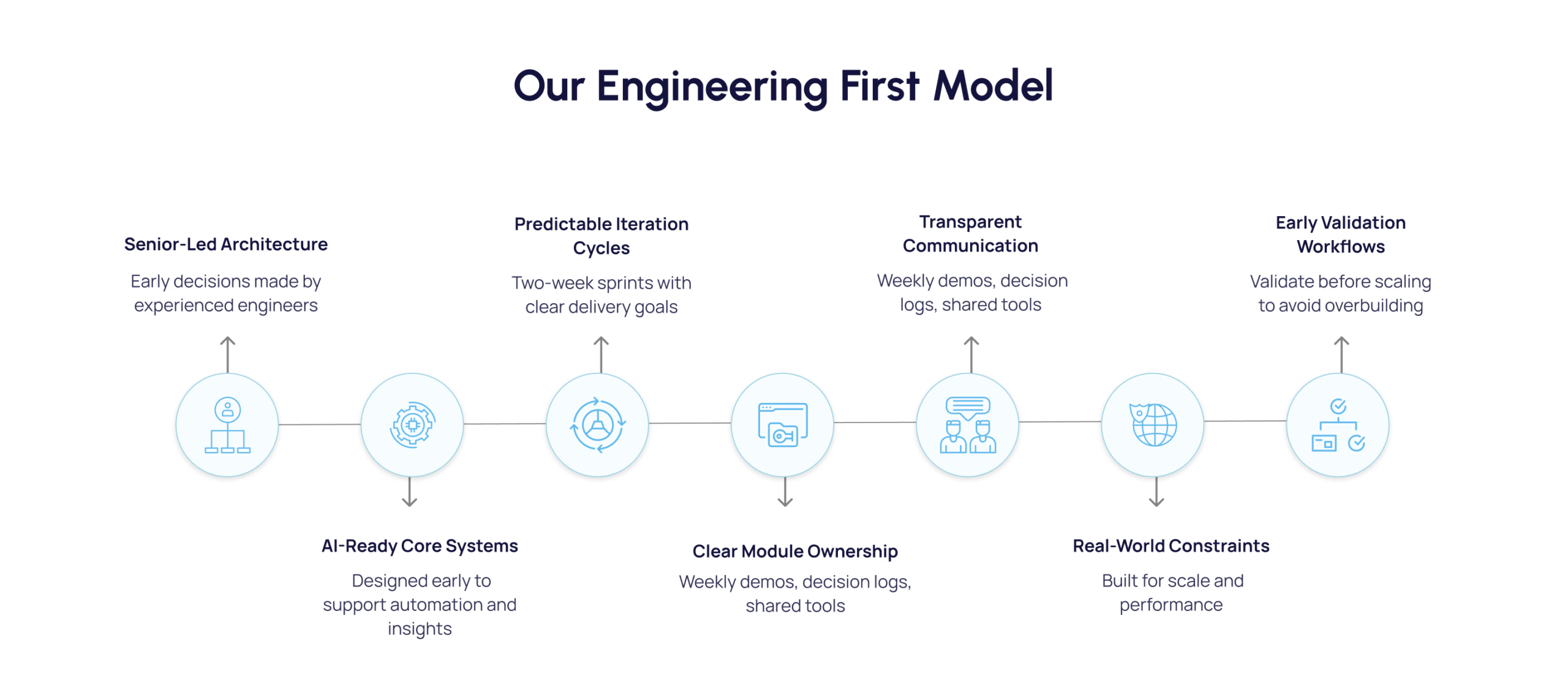
1. Senior Talent, Not Layers of Juniors
At Absolute App Labs, product execution is led directly by senior engineers with 10+ years of experience across SaaS and operational platforms. The same people who define the architecture are responsible for building and evolving the product.
This structure preserves context, shortens decision cycles, and reduces rework. Senior ownership ensures that engineers who have already navigated scaling challenges make early technical decisions, and that they understand which architectural patterns support flexibility rather than bottlenecks as the product grows.
2. End-to-End Senior Management Involvement
Traditional teams delegate execution after the initial discovery meetings.
But we stay hands-on throughout the engagement.
Our senior management remains actively engaged throughout your product development cycle, making us a team that founders choose when asked who can support their product long-term.
This means you get a development partnership in which your product stays aligned with its original intent as complexity increases, ensuring clarity, accountability, and zero dilution from sales-to-delivery handoffs.
3. Speed Without Compromise
We maintain two-week iteration cycles, assign clear module ownership, and keep the same senior team involved from start to finish so decisions are made close to the work.
We support this with our AI-powered Scrum model, which combines senior engineering expertise with AI-assisted execution. With Tools like Cursor.ai, we help reduce everyday execution cycles by improving code navigation, speeding up refactoring, and keeping documentation in sync. At the same time, our senior developers remain responsible for architecture and final decisions.
Here’s how this model plays out in practice.
One of our clients, a fintech founder, needed a working MVP to validate market fit. Using this model, we delivered a production-ready version in eight weeks, complete with stable APIs, reporting workflows, and a scalable foundation. This approach enabled the team to achieve predictable delivery and sustained momentum, despite tight timelines and evolving requirements.
4. AI-First Product Thinking
We often see founders asking who can build AI-ready products and how to integrate AI into their roadmap without later reworking core systems. As an AI product development partner, we plan for this at the architecture level from the start.
That means making early technical decisions that allow AI to be introduced later without disruption. Every solution we build is structured to support:
- AI automation through well-defined workflows and event-driven logic
- Insight engines backed by clean data models and query-ready pipelines
- Agentic workflows with clear task boundaries and system interfaces
- Data-based decision systems built on traceable inputs and outputs
By designing data models, APIs, and workflows around these capabilities upfront, products can add AI features without restructuring core logic. This ensures your AI adoption is guided by the long-term product strategy rather than driven by immediate, uncoordinated experiments.
5. Strong UX + Engineering Balance
Design and engineering often move independently, resulting in screens that look good but don’t function well, and features that work technically but fail real users.
But we integrate both disciplines from day one.
- Our design decisions reflect system constraints.
- Engineering decisions consider usability.
- Products that feel coherent, efficient, and intuitive.
This integrated approach means the product works as beautifully as it looks, and scales without compromise as your user base grows.
6. Transparent Communication
We operate with complete transparency as our default. You see the work as it happens, understand every decision, and have direct access to the team building your product.
Every engagement includes:
- Weekly demos with clear outcomes and next steps.
- Documented decisions that show what changed and why.
- Shared access to Figma, GitHub, and sprint boards so you always see the actual work.
- Direct communication with the core team with no delays.
With this clarity, founders stay ahead of decisions rather than reacting to surprises, and trust builds naturally over the course of the project.
7. Proven Execution Across Industries
We’ve worked across fintech, ecommerce, marketplaces, and operational platforms, each with distinct architectural constraints. Over time, this has shaped our approach to system design, focusing less on short-term implementation and more on the decisions that determine how a product performs as it scales.
Fintech (Finnpick)
In a fintech product handling rapidly changing market data, maintaining consistency became difficult as coverage expanded. We introduced structured ingestion, validation layers, and controlled update flows to enable data to scale reliably and support accurate downstream insights.
Industrial Retailer(Beaver Tools)
As the e-commerce platform’s traffic and order volume grew, backend performance began to strain. We introduced a more precise separation between background processing and live requests, enabling the system to scale while keeping the storefront responsive.
Legal Tech (Legal Buddy)
As the legal tech platform grew, managing documents, actions, and permissions became increasingly complex. We introduced structured workflows, role-based ownership, and more explicit rules to enable the system to scale while maintaining consistency and trust.
Nonprofit (Trail Advocacy & Construction) (GORC)
In an operations-focused product, tightly coupled workflows made changes risky over time. We introduced more precise process boundaries and coordination logic to enable the addition of new capabilities without destabilizing existing operations.
Consumer Retail (Hobby1)
As feature velocity increased in a consumer-facing product, core logic began to strain. We reorganized backend responsibilities and data handling to enable incremental rollout of new features without disrupting existing user flows.
This cross-industry experience helps us make stronger architectural decisions early, when they have the greatest impact. And, you get the benefit of pattern recognition from dozens of products, applied directly to your specific challenges.
8. Built For Long-Term Relationships
Most teams disappear after shipping the MVP. But, we don’t. More than 89% of our clients continue working with us beyond the first release.
Because we support:
- Scaling and performance improvements
- Roadmap evolution
- Architecture upgrades
- Long-term technical strategy
This continuity gives founders stability and space to focus on customers and growth while we manage their product’s evolution.
Conclusion
The product you build today shapes the company you can grow into tomorrow.
At Absolute App Labs, we’re built with it.
We operate with an engineering-first approach, so your product gets the clarity it needs from day one. As a result, most founders seeking the best product development teams for startups choose to work with us, and those who want a delivery focused on long-term, future-ready product value.
If you’re looking for a team that prioritizes sound architecture and long-term product health, we help you move forward with clarity and confidence.


