Founders and business leaders face a reality where software must be built faster, cost less, and still meet high-quality expectations. Yet development costs keep rising, teams remain lean, and delivery timelines often slip due to unclear requirements, technical debt, and coordination overhead.
For CEOs, COOs, and operations leaders, this creates uncertainty in planning and budgeting. Product and engineering leaders struggle to balance speed with quality, while rework and late-stage fixes consume valuable time and resources. Adopting new AI development tools offers a way to improve efficiency without the risk of costly experimentation.
AI developers have emerged as a practical solution in the technology landscape, directly addressing these pain points for founders and leaders.
What Do We Mean by “AI Developers”
Smart coding assistants that augment human teams, suggesting fixes or improvements. AI coding assistants can generate, review, and even deploy code, handling repetitive tasks so your team can focus on strategic, high-value work.
For example, modern AI Coding Assistants 2026, such as Cursor AI or GitHub Copilot, integrate into development environments to speed up coding and reduce errors. Some advanced AI agents can even coordinate end-to-end workflows, helping teams manage tasks from prototype to production.
Teams that work this way move faster, reduce wasted effort, and build products that truly stand out.
AI developers work by understanding context and executing tasks based on simple instructions. This helps your team deliver faster, make fewer mistakes, and ship more predictably. The ROI becomes visible through faster releases, reduced rework, and better cost control throughout the software development lifecycle.
Benefits Of Using AI In Software Development Lifecycle
When AI developers are applied deliberately across the software development lifecycle, they reduce execution challenges, improve delivery predictability, and help teams achieve measurable ROI from AI in SDLC.
3 Key Areas Where AI Accelerates Development
AI tools tackle delays in development by automating areas that typically consume the most time:
- Repeated Coding: AI can automatically generate repetitive code structures, reducing developers’ manual setup time.
- Testing and Debugging: Automated error detection helps identify bugs early, reducing the need for repeated fixes.
- Refactoring and Iteration: AI helps improve existing code quickly, speeding up feature releases and updates.
For example, in typical web application projects, tasks that previously took developers several hours can now be completed in minutes with AI-assisted workflows. Teams report 40 – 60% faster development cycles, enabling startups and scale-ups to launch products faster and iterate more often.
How AI Developers Help Reduce Overall Development Cost
Time saved naturally translates into cost savings. By leveraging AI, companies can achieve:
- Higher Productivity: Teams can deliver 2-3x more output.
- Lower Operational Costs: Teams reduce salary and overhead expenses by 20-40%.
- Reduced Error Costs: Early bug detection minimizes costly post-release fixes.
- Faster Onboarding: New developers ramp up more quickly when AI assists in coding and documentation.
Additionally, AI reduces the need for developers to spend time on repetitive tasks, allowing senior engineers to focus on strategy and architecture. Over time, these efficiencies compound, creating measurable ROI and more predictable budgets for startups and growing businesses.
Case Study: How Absolute App Labs Uses AI Developer
We, Absolute App Labs, an AI-first product development firm, use AI-powered development to help startups and SaaS companies launch faster and save costs.
The Situation:
While building an MVP for a SaaS client, our team faced a familiar constraint:
- Tight timelines
- Fixed budget
Around half of developers’ time was being spent on repetitive tasks, such as setting up APIs, fixing small bugs, refactoring code, and preparing builds. This slowed progress and increased cost pressure.
The Experiment:
Instead of increasing headcount, we ran a controlled experiment to identify the best AI development platforms for startups in 2026, specifically those that could help us deliver the MVP within fixed budgets. For one sprint:
- We introduced Cursor AI coding assistants only for our routine development tasks.
(We had previously detailed how Cursor fits into our React-based MVP workflow in this post: React + Cursor AI Tech Stack for Faster MVP Launches.)
- Human developers remained fully in control of architecture, decisions, and reviews
- AI was used to:
- Generate boilerplate code
- Assist in debugging
- Speed up minor feature updates
Our Goal: Reduce effort without changing team size or delivery standards.
What Changed:
- Developers spent up to 50% less time on repetitive work
- Debugging cycles were shortened by 30–40%
- Feature completion became 2–3x more predictable
Encouraged by the results, we expanded AI usage to additional workflows while keeping human oversight intact. By letting AI handle execution-heavy tasks, our engineers focused on:
- Architecture
- Performance
- Product logic
- Long-term scalability
This experiment became the foundation for our AI-powered development approach. We now follow three principles: start small, measure impact rigorously, and scale only when ROI is proven.
Is AI-Powered Development Right for Your Business?
AI-powered development works best if:
-
- Your team spends a significant portion of time on repetitive coding or debugging
- You need to speed up the time-to-market for new features or products
- You want to optimize costs without sacrificing quality
- You are building scalable software, such as SaaS products or internal apps
How To Apply AI-Powered Development: A Step-by-Step Approach
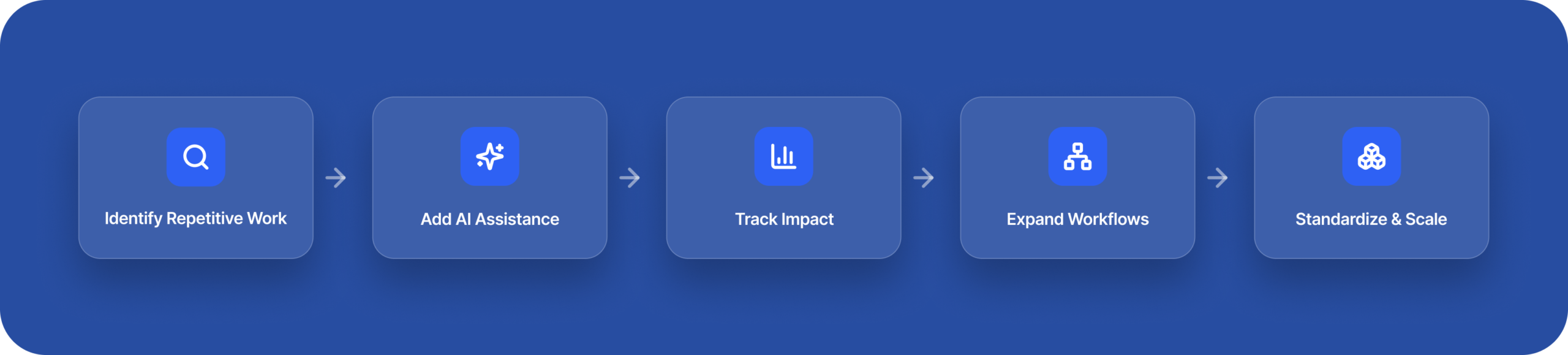
Step 1: Identify High-Effort, Low-Value Work
- Repetitive coding
- Bug fixing and testing
- Minor feature updates
Step 2: Introduce AI as a Developer Assistant
- Assist with code generation
- Suggest fixes and improvements
- Speed up testing and debugging
Step 3: Measure Business Impact
- Development cycle time
- Feature delivery speed
- Reduction in rework or defects
- Cost per feature or release
Step 4: Expand AI to End-to-End Workflows
- Feature planning
- Prototyping and iteration
- Release preparation
Step 5: Standardize and Scale
- Standardize AI-assisted workflows
- Train teams on best practices
- Scale adoption across projects
Conclusion
AI-powered development is all about faster delivery, controlling costs, and delivering with assurance. When applied thoughtfully, AI developers remove execution challenges, reduce rework, and even help small teams achieve more without increasing resources.
Absolute App Labs helps growing businesses with AI-powered development workflows that focus on faster delivery and reduced cost of development. If you’re looking to reduce development time and cost without compromising quality, let’s talk.
Reduce Development Cost Without Compromising Quality.
Address the developmental challenges with AI powered development approach without increasing headcount.
FAQ
Does AI-generated code actually increase technical debt?
AI can accelerate coding, but best practices and reviews are key. With proper oversight, technical debt remains minimal.
Is it cheaper to use AI tools in-house or hire an AI-specialized agency?
We’ve found that partnering with Absolute App Labs for AI-powered development delivers faster results and predictable costs, without the overhead of building an in-house AI team.
Does AI help with Quality Assurance and bug fixing?
Our AI workflows catch bugs early, automate testing, and reduce rework, letting your team deliver higher-quality software faster.
Can AI help with legacy system migration or just new projects?
Our AI-assisted processes work for both – modernizing legacy systems or building new applications from scratch.
How much can AI actually shorten our Time-to-Market?
By leveraging our AI-powered processes, clients can launch features 30–50% quicker, with predictable timelines. By leveraging our AI-powered processes, clients can launch features 30–50% quicker, with predictable timelines.


